Showing posts with label book. Show all posts

Sunday, June 13, 2010

Baccala al Prezzemolo

This recipe is a long-time favourite from Elizabeth Romer's "The Tuscan Year", and attributed to her friend (and subject of the book) Silvana. It takes a bit of preparation and time but not a lot of effort - it's a good one for the weekend.

Baccala

It always feels slightly ridiculous to pay more for baccala than for most kinds of fresh fish but it should be no great surprise. After all, prior to refrigeration a lot more effort was required to make sure fish could be kept for the innumerable Catholic fasting days (which, for Fridays at least, are still recommended).

Cod was plentiful through the middle ages, but not everywhere and not throughout the whole year, so for many centuries baccala was a major source of Friday protein. Baccala can safely be eaten during Lent without fear of The Man Upstairs Who Could Visit You With Plague And Could Do Scary Stuff With Lightning, so for most of history, baccala was what you ate when you were doing penance or abstinence. It is to fresh fish what ham is to pork - a means of once tiresome preservation, no longer required but still desired for its flavour.

Ingredients

Pellegrino Artusi, the nineteenth century author of La scienza in cucina e l'arte di mangiare bene (The Science of Cooking and the Art of Eating Well) managed his reader's expectations by telling them not to expect too much of baccala, and that seems to have been the spirit of the times. Like going to Church, it was dead boring but you did it because you had to. Artusi actually says at the end of his recipe for Baccala Fritto, "If ... you still find this to be an inferior dish, it is your fault for wanting to try it." So, having dampened your enthusiasm, why not try this wonderful dish? The fish has a dense, almost chewy texture and soft, creamy-fish flavour.
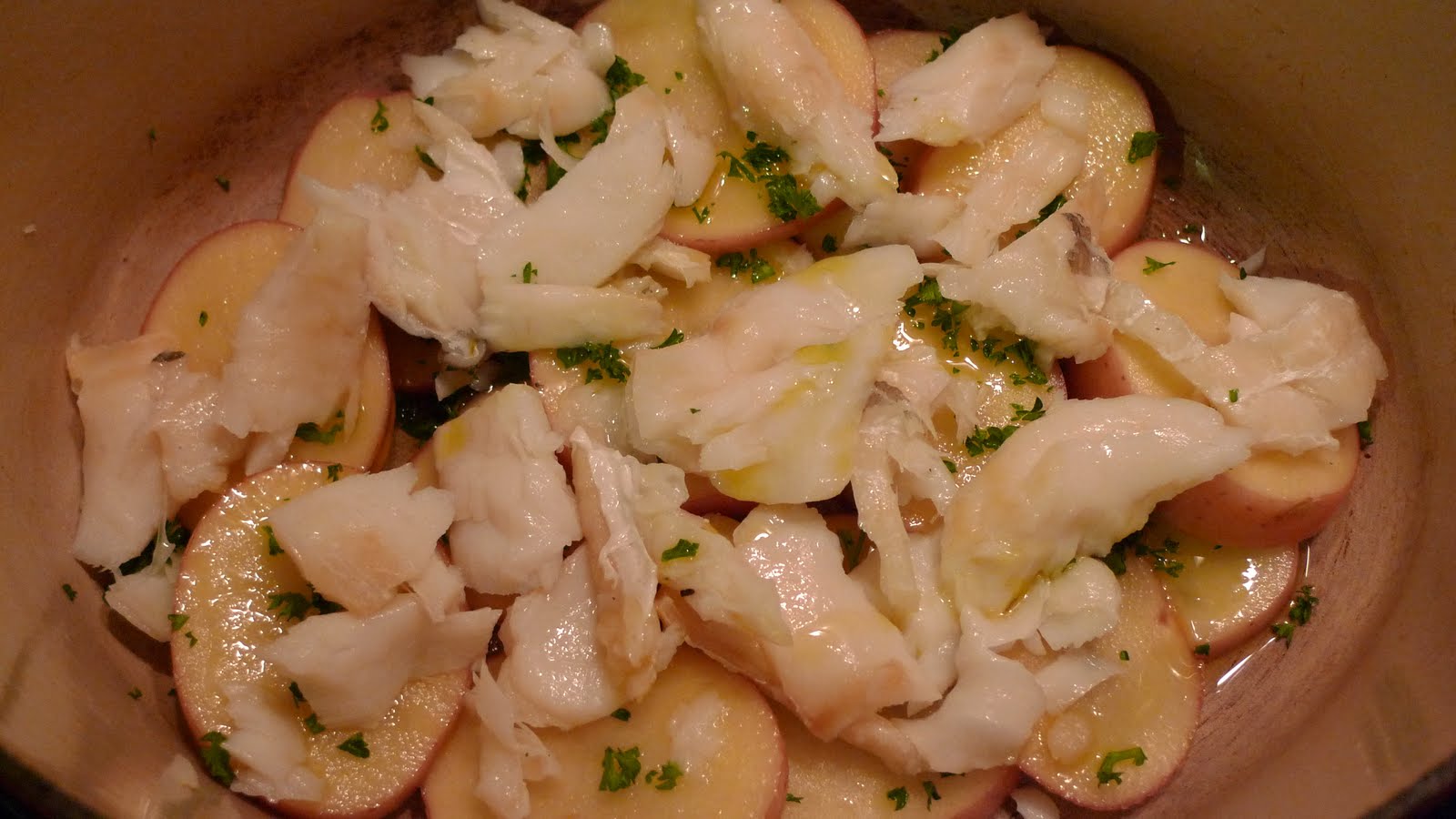
Layered fish and potatoes

So, the recipe.
  • 1kg or so of baccala. Whatever you do, remember baccala's the salty one - don't try and use stockfish which have been mummified instead of salted.
  • 500-700g potatoes
  • an onion
  • half a bunch of parsley
  • olive oil
  • a few ripe tomatoes
The day before, take the fillets of baccala and soak them in a lot of water for a day. Change the water a couple of times - there's a shirt-load of salt in them and things will get nasty if you don't. Gently simmer the fish in just enough water to cover for about 30 minutes and cool in the liquid. Flake the fish (removing the bones) but not too finely. Chop the parsley finely.

Hmmmmm....

Thinly slice the potatoes and the onion, and in a heavy casserole lubed up with olive oil, make layers of potato, fish, onion, parsley, anointing each layer with a drizzle of olive oil and a grind of pepper. Drizzle a little (a few tablespoons only) of the liquid the fish was cooked over the top and then add the sliced tomatoes. Stick into the oven for an hour or so until the potatoes are soft and have absorbed the flavours of the fish, onion and parsley. Fragrant and comforting - not a grand and pretentious dinner, but a warm and friendly dish for a cold winter weekend.

Thursday, June 3, 2010

Brillat-Savarin and the very bonnest of mots

A small divertissement, if you will be so kind as to indulge me.

This week I’ve been reading Brillat-Savarin’s “The Philosopher in the Kitchen” and it’s wonderful. I have a modest passion for the history of cooking and attitudes towards food and I’ve been meaning to read this for a while, but F dropped a copy in my lap and it’s been good cheer ever since.

Jean-Anthelme Brillat-Savarin wrote at a time when hyphens were plentiful and Napoleon was fading from memory. He was a lawyer and a politician, a violin player and teacher. His legend was written with the release of his “The Physiology of Taste” and dashed when he became the spiritual leader of Iron Chef.

It’s fun in the twenty-first century to read Brillat-Savarin and to savour the gap between his world and ours. For example, he offers a typology of gourmands which elevates the love of food to something close to deity. Some of us are doomed to be denied the pleasures of the (cooked) flesh, whilst others are born to lustfully enjoy oral (and gastronomical) sensual pleasures. To quote the man, “I believe in innate tendencies.” You either have it or you don’t.

Savarin (the cake, not the man)
photo by flickr user open-arms

The revolution is clearly long gone in France by the time Brillat-Savarin writes, and for him a man must be measured by his birthright (and his inherited assets). You can either enjoy the culinary arts with a pleasure that glides from the curves of velvety sensuality to the apex of fiery lust, or you can eat shit and die like a peasant. Are you with us, or do you smell like a turd in a barn? Anyone who calls financiers “the heroes of gourmandism” did not live in the same century as Macquarie Bank or Goldman Sachs.

Brillat-Savarin’s taxonomy of gourmands suggests his higher thoughts were well and truly taxed. Gourmands were born, and these could be spotted at a distance by their “ unusually acute perception of certain sensations” and a passion that “acts on the muscles… and… leaves visible traces, and so give a permanent and recognizable character to the physiognomy.”

Indeed, those predestined to be gourmands are “generally of medium height; they have round or square faces, bright eyes, small foreheads, short noses, full lips, and well-rounded chins.” Except, of course, for the women who love sweet things, for they, “have finer features, a more delicate air, neater figures, and above all, a very special way with their tongues.” Nurse!

Of course, those who “refused an aptitude for the pleasures of taste, have long faces, noses and eyes, whatever their height”… I’ve got a bad feeling that could be describing me.

In any event, Mr Brie has been a jolly good read and there’s much I want to share, cut into fat slices as befits a nineteenth century gentleman and gourmand, so over the next few weeks I’m going to dip into the old Jean-Anthelme Yeast-Cake and pull out some of the bonnest of mots. Bon appetite!