Showing posts with label cheese. Show all posts

Saturday, September 4, 2010

Cheese Club Nine - Bride of the Son of the Revenge of Cheese Club

Cheese Club returns for its ninth time, and frankly it was touch and go there for a few moments. A number of last minute withdrawals due to illness, morning sickness, hangovers and being in Malaysia (not all the same person) meant Team Cheese was a bit thin on the ground. This was exacerbated when co-host textileseahorse got bogged in the country rains and didn't arrive home until well after kick-off. Luckily, quality counts for much and I was joined by Eat Our Way stalwart essjay and Team Cheese star recruit, Dapper Del. So without a moment or skerrick of cheese to waste, let's hear from the cheese...

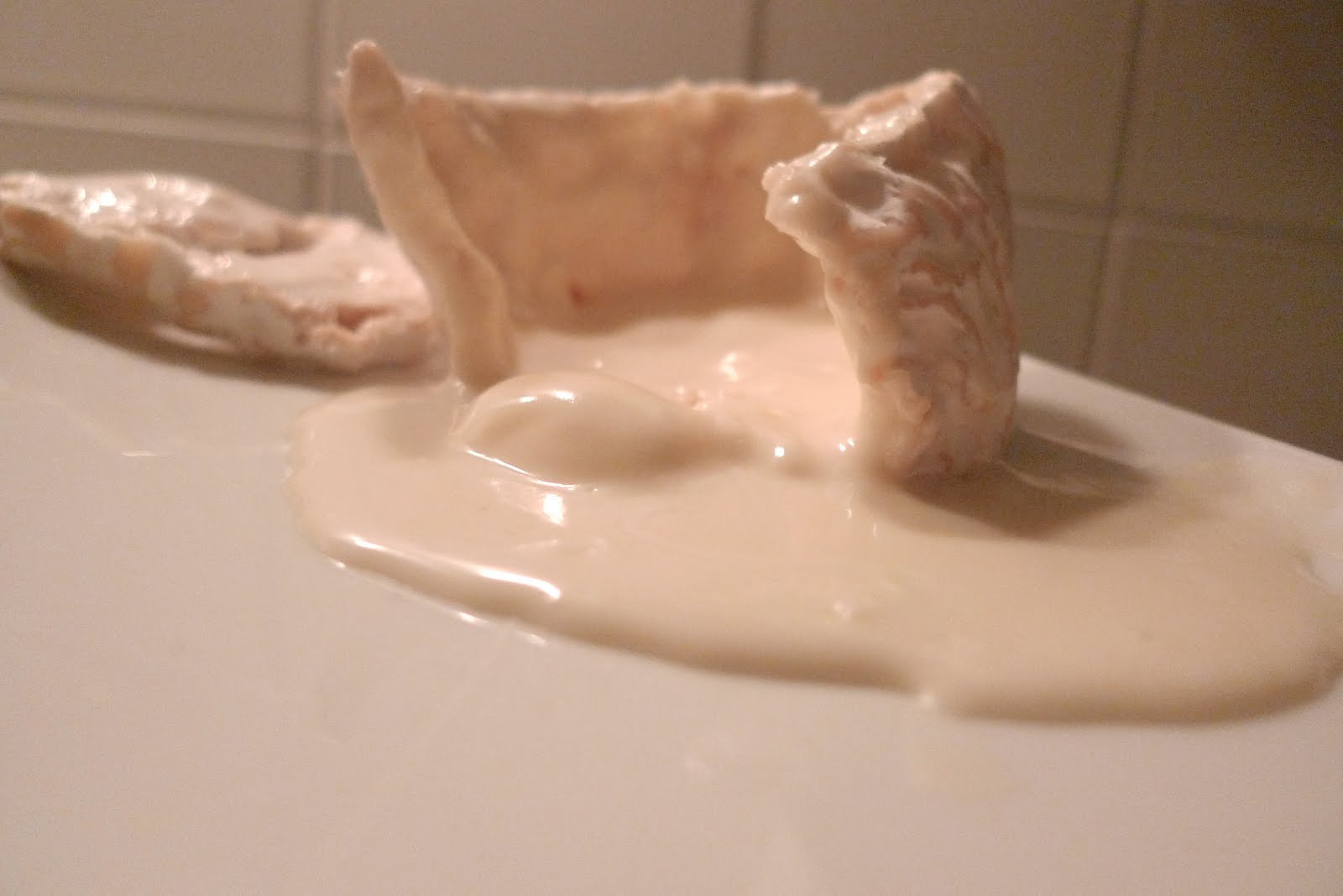
Holy Goat Batman! Let's put on our Batsuits and go rolling around in it!

Holy Goat Pandora - Holy liquid cheese, Batman! From the outside it looks like a lot of the other surface ripened, white mould goats cheeses (like this one) but on the inside it's something else all together. In fact, it's little more than a gooey, liquid cheese poured into a white mould tube cunningly disguised as something more solid. When I cut the top off ours, as if for a boiled egg, the texture inside was like a thin pouring cream with a small floating centre that hadn't quite ripened. Cutting the side resulted in a torrent of cheese that required bread to sop it up. Beyond the cream the flavour was slightly sweet with a little mushroom flavour and without any goat tang. A cheese that demands an audience.

Fromage de Meaux. Far, far better than a silk stocking full of shit

Fromage de Meaux - A cows' milk white moulder from Ile-de-France and like all great French cheeses, this Brie has a long and amusing history. Charlemagne praised Brie in the ninth century and it was dubbed "the King of Cheeses" by the diplomat Tallyrand (a man famously described by Napoleaon as "shit in a silk stocking") in the nineteenth. This was a lovely Brie, but not as intense or salty as some of the other French white-moulders we've had (such as the Brie de Nangis). A mild, rich flavour that's easy on the palate and doesn't require a whole lot of thinking. This is an introductory Brie, or perhaps a gateway Brie that leads the first-time taster to a life of crime to fund an obsession with the sterner stuff...

No, not "little monster"; Petit Munster. Same origin as "monastery"

Petit Munster - Not, as one might have been led to expect, a small monster, but instead a modest washed rind cheese from the Alsace. Although Munster is considered one of France's more smellier cheeses, this was the pocket-size model that don't have quite the same terrifying reputation as its large-wheel bigger brother. This is not an overwhelming washed-rind biological weapon, but is a beautiful cheese with a luscious, smooth texture and a balance of washed-rind stink and sweet cream. It doesn't have the yeast/Vegemite smell that some of its friends-and-relations do, but would be the perfect follow-on from the Brie on the path towards cheese dependancy.


Roy des Vallees, or we as like to call it, Master

Roy des Vallees - On the surface this appears to be a modest semi-hard cheese ball, about as big as a cantaloupe, made from sheep and goats milk in the Basque-Pyrenees. But its modest looks hide the fact that this cheese is a supervillain in a cardigan; one which DEMANDS TO BE DESCRIBED IN ALL-CAPS!! THIS IS A BLOODY MARVELOUS, RICH, NUTTY, CARAMEL FLAVOUR THAT LASTS ABOUT SIX MONTHS IN YOUR MOUTH! BOW BEFORE THE CHEESE, YOU COWERING, INSIGNIFICANT MORTALS FOR YOUR TIME HAS EXPIRED! THE TIME OF THE BIG CHEESE HAS ARRIVED AND YOU PUNY WALKING HUMAN SAUSAGES WILL BE RENDERED DOWN FOR TALLOW TO SERVE YOUR LACTIC OVERLORDS! BOW!

Sorry Cantal, you were nice but I was thinking about Roy...

Cantal - Cantal is semi-hard cow's milk cheese from Auvergne. It's texture was somewhere between a not-too-old Cheddar and a Gruyere - tight and smooth but with a dense flavour that has just a little sourness to balance the nuttiness. This suffered a little by following the Roy de Vallees, but stood proud when taken on its own the next day. At the time we all nodded and spoke highly of the Cantal, but secretly we are all thinking about the Roy...

Carles Roquefort

Carles Roquefort - The Lord knows I'm not a religious man, but every time when we finish Cheese Club with a soft, buttery blue cheese I can't help think that is How God Meant It To Be. All good things should end with blue cheese, and this would be a fine Roquefort to finish many things; a meal for example, or perhaps a long evening of wine, or even a life. Without getting onto the morbid subject of deathbed cheeses, this would have to be on the shortlist (although, to be fair, my shortlist has about 20 cheeses on it). Creamy yet tart with both a sheep's milk tang and a powerful blue punch, this is a noble and powerful cheese; the sort that looks imperiously down on you from the back of a horse. You don't argue with a cheese like this; you just don't.

Oh, and the mystery guest with the stripe? It's our old friend, Fin Briard aux Truffe

Friday, July 23, 2010

Cheese Club Eight - Night of the Living Curds

The gear

When a barman knows your name it's probably time to reflect on your life so far and wonder if the next few years should be quite as well lubricated as the last few (which, when you think about it, have gone past in a bit of a blur). I was having similar thoughts earlier in the week when Parma at the cheese shop not only recognised me but called me by name. Yes, I realise that I know her name as well, but that doesn't really make it any better.

Two of the Cheese Club 7

Nevertheless, Cheese Club carries on and, like my cholesterol levels, is ever growing. This month the Cheese Club crew grew to seven, so there was no shortage of opinions and definitely no shortage of wine. Team Cheese was textile seahorse, Tom, Francesca, Dandy, Scott, Eat our Way stalwart Elisabeth and myself. The challenge was facing six Italian cheeses with no assistance except for some wine, bread, cornichons and a few biscuits.

Revolutionary biscuits of Italy,
Rise up out of your box,
You have nothing to lose but your wafers
Yum, yum, yum.

(Alexei Sayle)

Two more of the Cheese Club 7

So without further ado, and definitely without any further revolutionary poetry, we begin...

Occell- Tuma dia Paja - like the Easter Show, but flatter

Occelli Tuma dia Paja - This is a humorously flat, striped white-moulder that looks like a Camembert that was sat on by a pig wearing corduroy. The texture was soft like a perfectly ripened Brie but not as dense, while the flavour was mild and rural. Scott described this as "smelling like the Easter Show" - a mixture of hay and farm animals, not surprising given these are ripened on straw. It's made from milk from cows, goats, sheep, ducks, sparrows and... sorry, got carried away there... No duck or sparrow milk, but it does have cow and goat, and the sheep milk was clearly evident. A very good cheese to eat before getting down to the real business of eating cheese.

Ribiola de Grotto - the 1960 station wagon of packaging

Ribiola di Grotto - The most surprisingly packaged cheese I've seen yet. Wrapped like a bar of soap and then a layer of thin wood laminate on top and bottom, it looks like the lactic equivalent of an 1960's woody station wagon. A washed rind, cow's milk, this is one of the best washed -rinders I've tasted in a while. The texture was perfectly smooth with the slight crunch of salt(?) crystals while the flavour was salty and creamy but balanced with the bright orange pungency. Described as "excellent drinking cheese", as each salty bite needed a mouthful of wine.

Occelli crutin tartufo

Occelli crutin tartufo - Regular readers might get the impression we've gone a little truffle-mad here at Eat our Way Up High Street and honestly, it's hard to argue otherwise. This is a cylinder of truffle infused, semi-hard cheese made from cow and goats milk and it left us all reeling. Crumbly, and without the truffle it would be a nice enough - medium fat with a goat tang to finish with. With the truffle though... Phroaghhhhh.... Like a boardroom in a 1980's advertising agency, we passed the plate around from nose to nose, snorting deeply and talking rubbish, such was the intensity of the aroma. Somebody said, "Christmas in July!" Truffles really need fat to help spread the love, and truffle-in-cheese can be even better than the otherwise madcap truffle butter. Pecorino with truffles has been a favourite for a while, but the Occelli is its glorious, scented peer.

Sovrano

Sovrano - a hard cooked cheese from Lombardy made from cow and buffalo milk. A slice from a much larger (35kg) wheel, this is a lovely, pale coloured hard cheese with a bright, slightly sweet flavour. It has a slight crystalline crunch and a long, rich finish balanced with a little tartness (but not too much). This was a hearts-and-minds cheese - a lovely hard cheese for shaving that's not so intense that it can't be used with reckless abandon (and you know how much we love reckless abandon).

Pasti with crumblepaste. Weird.

Pasti - Another hard cooked cheese, this one quite a bit more intense than the Sovrano. It was a much darker, almost orange colour and had a flavour was deep and complex - rich and buttery but with esters that emphasise tropical fruit fragrances. Very intense and crumbly but with an odd textural finish. There were a few awkward moments as we looked at each other wondering, "am I the only one?" but it was consistent for all of us. The cheese 'clumped' and stuck in lumps to our back teeth. Nothing a cleansing raisin or bit of bread wouldn't fix, but disconcerting nonetheless. An intense success, but don't say I didn't warn you about that finish...

Erborinato

Erborinato - A cow's milk cheese attacked with all sorts of wonderful infection, being both a washed-rind and a blue-moulder. This was a cute, fist-sized cylinder with a cute, fist-sized punch. Soft, but the smooth, creamy soft of a washed rind cheese rather than a buttery blue. I can imagine the battle between the blue mould and the orange mould could leave large tracts of land uninhabitable with fall-out, but this cheese brings them together in a controlled way, balancing the competing forces into something pretty special. The blue is intense but it's a broad intensity, like a punch in the head, rather than a scalpel-scythe to the palate.

Another great moment in Cheese Club history.

Monday, June 14, 2010

Cheese Club Seven - Whey to go, dude!

Friday night was Cheese Club night, and on this night we shared it with Suzanne, aka essjay, some lovely wine, the usual accompaniments and were aided by a copy of French Cheeses by Kazuko Masui and Tomoko Tamada (which we will return shortly, promise). As Cheese Club goes, this was heavy on the semi-hard and hard cheeses and with a preponderance of Appellation d'Origine Controlee cheeses. AOC, for those who don't know, is a French expression translating roughly as "we know where it came from because it says so on the label". This edition of Cheese Club was an intense, high-powered occasion with some strident flavours wearing the gastronomic equivalents of shoulder pads and power suits, and was joined with some vin-not-so-ordinaire, including a jolly 2005 Curly Flat Pinot Noir. Noice.

Saint Mercellin. Think you're a tough guy, eh?

Saint Marcellin - Superficially, this comes from the same family as the Saint Felicien we've previously loved. But this is the younger brother - the one with short-guy Napoleon complex. Like the Saint Felicien, it comes in its own ashtray and looks like its skin is the only thing holding it together. Underneath, however, it's aching for a fight and is ready to punch you in the face before running away and taunting you from *just* outside striking distance. Like the best French cheeses, it comes with a legend involving a bear, a future King, two woodsmen and a particle accelerator (OK, so I made up the last bit) but the legend is more than 500 years old and so can be described as "venerable". The cheese is smooth and thin-creamy like the Felicien, but has a much stronger and intrusive flavour.

Agour Pur Chevre

Agour Pur Chevre - This has the lovely white, near-translucency of a semi-hard goat's cheese and is from the Basque Pyrenees in France. Amazingly nutty and smooth, almost-hard texture with just the barest whisker of crystalline crunch. If it wasn't for the ivory colour, I would have assumed this was cow's milk. Nutty and smooth like a cooked curd cheese, but with a lighter finish. Lovely.

Comte heaven

Will Studd Select Comte (AOC) - This is a Gruyere of mighty power and lusciousness and is the most popular of all cheeses in France (I read it in a book so it must be true). It's a Gruyere, so it's smooth and a bit nutty, but this one was stratospherically luscious, moist and sweet as well. The flavour had a slight caramel and the texture was as smooth as a very smooth thing that was having a particularly smooth day. Fondue heaven awaits, and it's not in the back seat of a limo - it's in a slice of this.

Heidi Tilsit - relax...

Heidi Tilsit - This is a Tasmanian semi-hard washed rind cheese of cow's milk. In previous editions of Cheese Club, I've mocked Heidi as various Swiss cheeses have come up, but I haven't actually had a cheese named after the lass herself. This is much more of a soft, elastic cheese than most Swiss-style cheeses, and although it has a rich flavour with a nice follow-up tang, it just didn't come together as well as some of the others. A good cheese, to be sure, but on this night we tasted so many similar cheeses that were much more intense and exciting. The RHCL tasting notes talk about a wet-hay flavour, and who am I to argue? But equally, who am I to care?

Abondance. &^%$ yeah.

Abondance (AOC) - From the same family as the Comte, another mountain cheese. This one's made from raw cow's milk, so in theory (according to Quarantine), this one should taste of instant lactic death. While many of the cheeses in this family look pretty similar, this one has distinctive concave sides and it is obviously a drier cheese than the others. Of the four semi/hard fondue-style cheeses, this is far and away the most intense, with less nutty-smoothness and more a vigorous tang. This is a sharp and big, pointed cheese which should be approached with caution and much respect.

Blue de Laqueuille

Bleu de Laqueuille (AOC) - When I was growing up there were (as far as I can remember) about three different types of cheeses. One of them was a blue cheese, and it tasted remarkably like the Laqueuille, although it was called "Danish Blue". This is a lovely cow's milk blue cheese that has soft and rich paste without being buttery and can still crumble, and a strong but not frightening degree of blue mould. Not quite the blue cheese of my childhood, but a lot like it.

Thursday, June 3, 2010

Brillat-Savarin and the very bonnest of mots

A small divertissement, if you will be so kind as to indulge me.

This week I’ve been reading Brillat-Savarin’s “The Philosopher in the Kitchen” and it’s wonderful. I have a modest passion for the history of cooking and attitudes towards food and I’ve been meaning to read this for a while, but F dropped a copy in my lap and it’s been good cheer ever since.

Jean-Anthelme Brillat-Savarin wrote at a time when hyphens were plentiful and Napoleon was fading from memory. He was a lawyer and a politician, a violin player and teacher. His legend was written with the release of his “The Physiology of Taste” and dashed when he became the spiritual leader of Iron Chef.

It’s fun in the twenty-first century to read Brillat-Savarin and to savour the gap between his world and ours. For example, he offers a typology of gourmands which elevates the love of food to something close to deity. Some of us are doomed to be denied the pleasures of the (cooked) flesh, whilst others are born to lustfully enjoy oral (and gastronomical) sensual pleasures. To quote the man, “I believe in innate tendencies.” You either have it or you don’t.

Savarin (the cake, not the man)
photo by flickr user open-arms

The revolution is clearly long gone in France by the time Brillat-Savarin writes, and for him a man must be measured by his birthright (and his inherited assets). You can either enjoy the culinary arts with a pleasure that glides from the curves of velvety sensuality to the apex of fiery lust, or you can eat shit and die like a peasant. Are you with us, or do you smell like a turd in a barn? Anyone who calls financiers “the heroes of gourmandism” did not live in the same century as Macquarie Bank or Goldman Sachs.

Brillat-Savarin’s taxonomy of gourmands suggests his higher thoughts were well and truly taxed. Gourmands were born, and these could be spotted at a distance by their “ unusually acute perception of certain sensations” and a passion that “acts on the muscles… and… leaves visible traces, and so give a permanent and recognizable character to the physiognomy.”

Indeed, those predestined to be gourmands are “generally of medium height; they have round or square faces, bright eyes, small foreheads, short noses, full lips, and well-rounded chins.” Except, of course, for the women who love sweet things, for they, “have finer features, a more delicate air, neater figures, and above all, a very special way with their tongues.” Nurse!

Of course, those who “refused an aptitude for the pleasures of taste, have long faces, noses and eyes, whatever their height”… I’ve got a bad feeling that could be describing me.

In any event, Mr Brie has been a jolly good read and there’s much I want to share, cut into fat slices as befits a nineteenth century gentleman and gourmand, so over the next few weeks I’m going to dip into the old Jean-Anthelme Yeast-Cake and pull out some of the bonnest of mots. Bon appetite!

Sunday, May 9, 2010

Cheese Club Six - Revenge of the Curds

Hardcore Neutrality

Cheese Club has returned, this time with revenge, vengeance, more revenge, a club with nails in it and a glass of wine. Oh, it's had sand kicked in its face by a buff lifesaver before, but now it's back with cheeses strong and ruthless enough to melt your head from the inside out. So surrender now, before Cheese Club gets all fromagier on your arses (or "asses" for our American friends).

Perigord goo

Besace Chevre Affine - After the damning-with-faint-praise disappointment of the Le Chevrot during the last Cheese Club goat experience, expectations weren't high for the Besace. Expectations weren't helped by the sight of this ugly, abstract beast of a cheese. Between the normal wrinkles of a surface-ripened goats cheese; a light dusting of ash; a protuberant, translucent layer of soft-ripened flesh; and a shading of blue and grey mould over the surface, this cheese would strike terror into the weak of heart. But not into mine, oh no. And lo, I was rewarded, for this is a cheese of Perigord and 0f glory. Although it had a modest heart of chalky fudge, it was mostly surface-ripened gooeyness. It was light on the goat tang (while still being balanced) and rich in the layers of mould and flavour. Oh, I love this.... Oh... Oh... I'll umm... stop now. People are watching.

Oh lord... Less than pretty. But so wonderful...

Rouzaire Camembert - As regular readers (I'll return your mower on Sunday) will know, I'm historically not a big fan of the surface-ripened white-moulders, but you know what? I'm beginning to come around. We've had some great ones (the Brie de Nangus in particular) with deep, earthy flavours, and this Camembert is close to its equal in raw power. Still with a stripe of chalky crumblation in the center, it was soft but firm with a rich flavour of mushrooms and cauliflower. This is glorious, but in a relaxed way. It's still got a week before it ripens properly but still, eh? Eh?

I want to believe

Saint Vernier - This episode of Cheese Club was turning into a lesson of surprising power, but this is the exception that proves the rule. Washed rind in name; washed rind in appearance but white-moulder in taste. Weirdly, this was a far milder cheese than the Camembert. A glorious orange tint underneath a white-mould fuzz, this looks like a small Camenbert that's been inadvertently tinted. And that's what it tastes like. It has a subtle washed-rind stink (if that's not a contradiction in terms), but once you taste it you wonder where all that smell went to. This still has some chalk in the centre, so I'll give this one a couple of weeks and see what happens. Sweet packaging by the way: it nestles softly in a plywood sunflower. Awwwwwww.

Nothing to fear here

Coolea - Coolea is an Irish, cow's milk cooked curd cheese in a Dutch style. Obviously. This was a couple of years old and was a luscious, buttery cheese with an intense nutty and caramel flavour. It still has a little cooked-curd smoothness, but with an almost imperceptible grain. It's not as an intense as the Lindenhoff, and thus isn't subject to enforceable standoff distances, but it is still wonderfully intense. Deep without being scary, like Radio National. Wash it down with a Toohey's Old or a 3 Ravens smokey one.

Coolea than you'll ever be

L'Etivaz - I have this ongoing problem reconciling my Cheese Club experiences with the proclaimed neutrality of the Swiss. This picturesque, peace-loving, clock-making nation, supposedly wielding nothing more dangerous than an implement designed to remove stones from horse's hooves, produces cheeses that our Aunt Agatha describes as "total ball-tearers". Of course, aunts have changed since Bertie Wooster had them, but these cheeses haven't. And L'Etivaz has all of the rich, grinding gorgeousness of an older, more voluptuous hard cooked curd cheese. Swiss cows that live downstairs in chalets; milk cooked over wood fires; banks that respect anonymity. What a life...

L'Etivaz. Stand well back.

Crozier Blue - Carrying on this edition's focus on intensity and approachability, the Crozier Blue is a blue sheep's milk cheese from Tipperary, meaning the UK is effectively surrounded by tart Roquefort-style cheeses, both East and West. I'd be surrendering pretty much straight away if I was them, hopefully to be welcomed into the creamy acidity. Lovely blue tart balanced with a soft texture, buttery but light. Again, a cheese intense but not overwhelming. This is an excuse to open a bottle of something sticky, and so I shall.

Crozier Blue. Nothing to add.

Tuesday, March 30, 2010

Cheese Club V - The Cheeses and Dairy Chain*


Cheese Club is back, this time with a hardcore experience for the strong of heart, steady of resolve and supple of liver. There were moments of calm and light, but most of all it was full-on, full-tilt, three-chord screaming and messing with your head. We were joined by Miranda, James and Felix, the Hyphen-Warlocks, and some continent-spanning wines, from the lovely Vasse Felix Shiraz in the west to the perky Brokenwood Cricket Pitch in the east. And so, down to business...

Le Chevrot. Yeah, ok....

Le Chevrot - you know the biggest problem with Cheese Club, apart from the cholesterol? Expectations are raised; raised some more; and, just when you think there's no cheese ceiling left to shatter, you're brought crashing down to Earth covered in feathers and goo. And that's what le Chevrot was to me - a nice enough surface ripened goat's milk cheese, but that's all. A gentle goaty tang; some almost interesting (but calming) white mould and a mostly uniform texture. With a ruffled skin it was largely homogenous, and most unlike some of the other more interesting surface-ripened goat cheeses we've tried (say, the Buche Chevre de Poitou). Like Richard Dawkins, it's enjoyable without recourse to magic.


Making moonlight music; mighty nice**

Fin Briard aux Truffe -This is basically just a brie with a layer in the middle infested with truffles. Yeah, yeah, yeah. So it's a surface-ripened cow's milk cheese with some black bits in the middle. But... But.... What are those black bits again?

This is wonderful stuff. The texture is just like a lovely brie - creamy with a moment of chalk in the middle and a soft and fuzzy rind, but the flavour is deep, sweet and richly earthy. Most of the flavour is in your nose, and it's a warm, infused flavour that comes from underground. If chocolate, compost, damp gardens, beef stock and a touch of Vegemite could combine into something grand, it would be this. We didn't taste much but the memory remains...

Miranda told me the next day she dreamed of this

St Felicien - This made me feel like a cat in heaven, but only because it's like drinking cream from a saucer. I could nod politely; I could roll this around in my mouth while making "hmmmmm..." noises; I could "ummm" and "ahhhh...", but this is like nothing we've had in Cheese Club to date, and by criminy, it's amazing....

It comes in its own terracotta landing pod and with its wrinkled skin looks like a Dr Who brain-villain lurking in the bottom of a gravel quarry. To quote Felicity; "it tastes like it's alive!" But then when you stick a knife in it, it dies quickly and liquifies. This isn't eating cheese; it's drinking cheese. A mild, gentle flavour and texture like thin pouring cream, like a cheese-stick drinking yoghurt... A Lady Gaga cheese - sexy, but thin and a little bit disturbing.


Polish your shoes, guvvna?

Pave de L'Ayeron - Oh no... I'm getting the fear.... This is seriously weird stuff, man... Dennis-Hopper-in-a-tweed-jacket-and-tutu weird... This is a sheep's milk washed-rind cheese; a cheese that looks runny and gooey with a crust of soft, warm colour that speaks of a luscious mouth-feel and a gentle but assertive washed-rind flavour. And it is those things, but it's got something else that takes it beyond the creamy towards a perverse, glue-sniffing experience. It has undertones of industrial solvent and, to quote Emily, the scent of shoe polish. This cheese is beyond good and evil and anything we don't eat will need to be disposed of in a concrete and lead-lined pit. I will eat some more, but mostly out of morbid curiosity.

Careful with that axe, Eugene.

Lindenhoff Aged Boerenkaas - This is the cheese equivalent of an aging hippie turned into a knife-wielding lunatic. In theory it's a Gouda, so it's a cooked curd cheese made of cow's milk, but the Dutch have been keeping this one in their stash for the last four years, next to the golden hash from Morocco and the hydroponic skunk weed. It looks nothing like those soft, doughy balls of flab that I usually associate with Gouda, but instead crumbles like a hard cheese, while the intensity of the flavour is like being stabbed in the head with a windmill full of clogs. Crumbly, crunchy moments (of calcium crystals, apparently) in a rich, stewed, deep flavour with a vicious edge. I'll be cooking with the rest of this - it's far too intense to expose to the naked human taste bud, but should be fantastic in a sauce with broccoli...

A little bit sexy, but only a little bit

Bonta Della Bontazola - This is a creamy blue cow's milk cheese that is near the bottom rung in the intensity hierarchy of Gorgonzolas. At the sharp, pointed peak sits the Gorgonzola piccante, a very blue cheese with a strong tang against a creamy base. In the middle is the Gorgonzola Dolce, just as creamy but with a milder blue mould tang. Almost at the bottom, just above cream, is this Bontazola - a rich, creamy and smooth cheese with just a hint of blue. This is very much the dessert cheese. Cheerful without being assertive, like that nice councillor you know, only a little more blue and without the sandals.


*I can't take the credit for this. It belongs to Alex James, Blur's bass player and cheesemaker.
** with apologies to Dr Seuss.

Tuesday, February 16, 2010

Cheese Club IV - Death to the Lactose Intolerant

Cheese Club has returned for the first time in a while but was well worth the wait. Joined again by the Urbane Parents and Penny and Kent, we glided our way through six wonderful cheeses and some wonderful wines (a 2007 Clockwork Cab Sauv (Margaret River); a 2000 Elizabeth Semillon (Hunter Valley) and a 2007 Scotchmans Hill Pinot Noir (Bellarine Peninsular)). So without further faffing about...

Cheese! In a box!

Holy Goat Eclipse - Kicking off with a surface ripened, fresh goats cheese, this was a sweet and ugly pyramid of joy. From central Victoria, this was a perfect balance of sweet and sour; lightness and depth. It had a consistent texture of tight, fresh curd (unlike the chalky centre and runny edges of, say, the Chabichou du Poitou), and the flavour was fresh and exciting. Very much a Quasimodo cheese - a little terrifying to look at with its curled, dark rind but sweet and gentle to know.

Holy Goat, Batman! It's as ugly as something really, really ugly!

That's Amore Smoked Baby Scamorza - The other Victorian cheese, this is a smoked and stretched curd cheese, bundled in to a little ball of mozzarella-like cuteness and burnished with a bronze sheen. The curd wasn't as stretched as mozzarella though, and although it had a bit of bounce it was softer than it looked. It had a salami-like, smoked smell, but the richness of the cheese is not overwhelmed by the burny stuff. Very popular on the night, and the best smoked cheese I've ever tasted (out of a small pool, to be fair...).

No ashtray necessary

Edel de Cleron - a washed rind cheese for those who don't necessarily believe that "washed rind" is the same as "biological warfare". This is a cow's milk, surface ripened and washed rind cheese that has all of the rich, gooeyness of a white mould cheese and the flavours of something heaven sent. The washed rind aspect was powerful but not overpowering and the texture varied from the ripe, gooey centre to the resisting rind. It had many layers of scent tussled together into a luscious whole. I think we'll leave the remaining half of this for a week to complete ripening - everything was so wonderfully complicated about this that a bit of time might produce something even more amazing.

Hmmmm.... Just you wait, my pretty...

Fougerous Rouzaire - a Brie, a lot like the Brie de Nangus - strong, earthy flavours; more salt than most local white-mould cheeses but not quite as salty as the Nangus. Popular with the white-moulders. Me? Yeah, as good as any, but I'm not really in a white mould mood. This wasn't on RHCL's recommended list but was an addition to satisfy those pesky white-moulders. Let 'em have their cheese I say. More of the others for me.

Quite nice, but you're going to have to get up earlier in the morning to impress me.

Casa Madaio Acacio de Bufala is made from Buffalo's milk and is a hard, cooked curd cheese from Eboli, Italy. This was definitely the most unusual cheese of the six. Penny described it as being "like a Manchego without the sheep's milk taste", which was a good call. It's texture was unexpected - while it looks like a hard granular cheese, it has a hint of resistance almost like a stretched curd cheese.

The flavour is big and round - the tasting notes talk about a "rich apricot fruity flavour". It certainly has a lovely acid balance and a bit of salt . I'm not quite sure what to make of this; I liked it, but ate it frowning in concentration. Not necessarily one I'd buy again, but only because there are so many other cheeses to try.

Things that make you "Hmmm?"

The last cheese of the evening was Onetik Bluette, a blue mould goat's milk cheese from the Pyrenees-Atlantiques, France. Quite frankly, this knocked everyone's socks off without the sense (or smell) that somebody had just taken their socks off, and was a perfect cheese to finish with. The texture was a blend of softly buttery paste and the slight grain of the mighty mould veins. A blue that everyone could enjoy, without it being bland - not so much sharp as tingly. This could easily become a new favourite and is on the "keeper" list and the "buying again" list and the "yes please" list.

Things that make you go "yummmmm..."

We also took delivery of some Aphrodite Haloumi, from Cyprus. I'll grill that and report back later. All in all an excellent haul.

Monday, November 9, 2009

Cheesy Twirly Blue(y) Goodness

I bought a piece of beautiful Roquefort today; Roquofort Carles. It was spectacular - creamy, crumbly, buttery and sharp; rich yet deeply salty and with a perfect tang.

You can read some more about it here (although be warned - the language verges on the wank and contains the word "artisanal") and I can recommend their website almost as much as the cheese. Once you see that arrow go around, you know it's the good stuff.

In the words of Google Translate:
"Placed on span of oak wood in magnificent caves naturally ventilated by a stream of air continuously cool and wet, Roquefort Carles will be refined for a few months later his inimitable flavor."
So, I raise a glass of Seppeltsfield Grand Muscat, sip quietly and wish my mouth would stop shouting at me. Wonderful, and full of his inimitable flavor.

Monday, August 31, 2009

The third rule of Cheese Club is if someone says "stop" or goes limp, it's time to stop eating cheese

Cheese Club arrived again. Life is good, although my cholesterol is probably stratospheric so I shall continue to avoid having it measured. This bunch went from the "ho-humm" to the sublime to the "OMG WTF BBQ!" At least one here fails the urbane scrumping Cheese Club test of bare-chested Brad Pittism, but there are a few that will rail against the materialism and alienation of modern life while tearing your ears off. You may go limp, but you won't say "stop".

Chabichou du Poitou is a fresh, white mould goats cheese, and not surprisingly was similar to the previously loved Buche Chevre du Poitou. Like that cheese it had a series of layers of various degrees of ripeness, although the Chabichou had a thicker chalky centre with a lovely, goaty, lemony tang and less of the creamy layer of the Buche. On the outside was beautifully wrinkled skin like a Shar Pei, although there is nothing else doggy about it. Cleansing but still rich, like a goats cheese should be.

The Brie de Nangis was a lovely, perfectly ripe Brie, with a gooey, runny middle ("it's runnier than you like, Sir...") and a big flavour as far as Brie goes. To do this cheese justice you have to try and forget years of average, bland Bries that offer a smooth texture and not much else. This is as strong a Brie as I have tasted, and its slightly mushroom, sexy scent will stay in my mind until the next disappointing Brie. Until then, however, whooooaghhhhhh.......

Fromagella di Capra
Fromagella di Capra. Oh yes, this is the stuff for me. An Italian washed rind cheese of goats milk, it had a luscious creamy texture followed up with an elegant fist in the ear of flavour. Strong and rounded without being in the washed rind stinky league, although I think I'm not only becoming immune to increasingly orange rinds, but beginning to demand them. Today is father's day, and this is how I'm celebrating...

Jean's Cow Goat
Jean Faup Vache Chevre - So, this is Jean Faup's Cow Goat (ok, so my translation is a bit literal), or at least is made of both kinds of milk. Semi-hard, smear-ripened it is rippled with small holes. The texture is creamy with a little firmness, like a very soft Emmentaler and the layers of flavour are intense but still subtle. I kept going back trying more, looking for the goatyness (at least, that was my excuse) but I couldn't find it, although I suspect it made the cheese lighter than it would otherwise have been. Lovely, lovely, lovely.

Tete de Moine - a Swiss, hard cooked cow's milk cheese. Strong, nutty and with a powerful and complex perfume, it's the bovver boy of the bunch, although the Fromagella di Capri is leering from behind the Tete's back. There's apparently a gadget you can by to shave the Tete de Moine with (because cheese with stubble is a little too casual), and I can imagine it sitting in the back of the second drawer in the kitchen doing the good work of the goddess Anoia. Unlike the gadget though, I will go back to this cheese again and again. So, to the monks of Bellaly Abbey we say "thank you for this glorious cheese. Oh, and sorry your abbey got turned into psychiatric clinic."

Rochebaron is a cow's milk cheese that looks and feels a bit like a white mould cheese but is also a blue, apparently. I say apparently, because although I can see small pockets of blue, it was exceptionally mild and like a not-very-inspiring brie. It looked like a Camembert dusted in charcoal. Best described as "safe for the kiddies". Everyone else liked it but I.... well, I like the sterner stuff.

(From top left corner, clockwise: Rochebaron, Chabichou du Poitou, Jean Feap Vache Chevre , Fromagella di Capri and Tete de Moine. The Brie de Nangis looked like Brie.)