Showing posts with label french. Show all posts

Saturday, September 4, 2010

Cheese Club Nine - Bride of the Son of the Revenge of Cheese Club

Cheese Club returns for its ninth time, and frankly it was touch and go there for a few moments. A number of last minute withdrawals due to illness, morning sickness, hangovers and being in Malaysia (not all the same person) meant Team Cheese was a bit thin on the ground. This was exacerbated when co-host textileseahorse got bogged in the country rains and didn't arrive home until well after kick-off. Luckily, quality counts for much and I was joined by Eat Our Way stalwart essjay and Team Cheese star recruit, Dapper Del. So without a moment or skerrick of cheese to waste, let's hear from the cheese...

Holy Goat Batman! Let's put on our Batsuits and go rolling around in it!

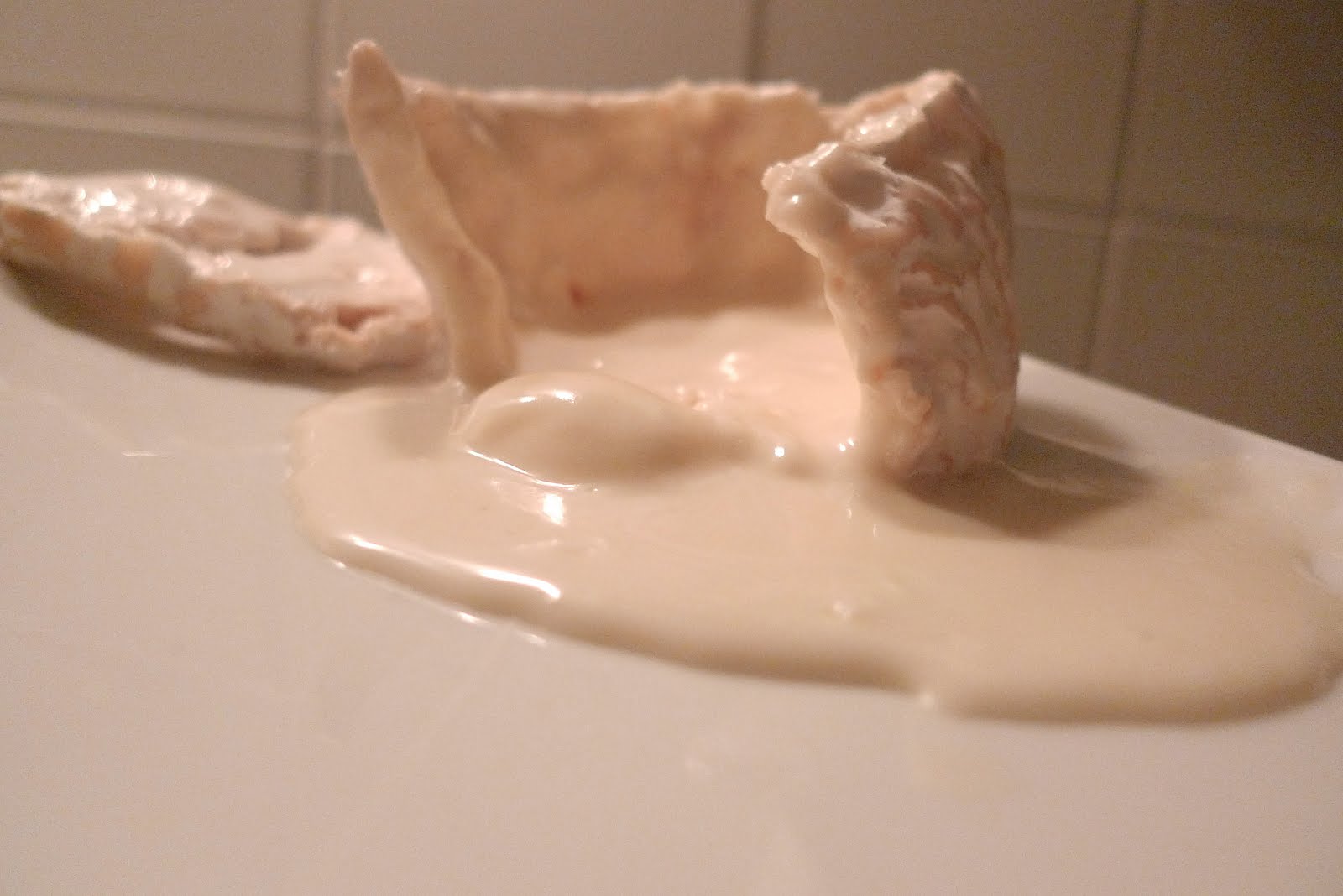
Holy Goat Pandora - Holy liquid cheese, Batman! From the outside it looks like a lot of the other surface ripened, white mould goats cheeses (like this one) but on the inside it's something else all together. In fact, it's little more than a gooey, liquid cheese poured into a white mould tube cunningly disguised as something more solid. When I cut the top off ours, as if for a boiled egg, the texture inside was like a thin pouring cream with a small floating centre that hadn't quite ripened. Cutting the side resulted in a torrent of cheese that required bread to sop it up. Beyond the cream the flavour was slightly sweet with a little mushroom flavour and without any goat tang. A cheese that demands an audience.

Fromage de Meaux. Far, far better than a silk stocking full of shit

Fromage de Meaux - A cows' milk white moulder from Ile-de-France and like all great French cheeses, this Brie has a long and amusing history. Charlemagne praised Brie in the ninth century and it was dubbed "the King of Cheeses" by the diplomat Tallyrand (a man famously described by Napoleaon as "shit in a silk stocking") in the nineteenth. This was a lovely Brie, but not as intense or salty as some of the other French white-moulders we've had (such as the Brie de Nangis). A mild, rich flavour that's easy on the palate and doesn't require a whole lot of thinking. This is an introductory Brie, or perhaps a gateway Brie that leads the first-time taster to a life of crime to fund an obsession with the sterner stuff...

No, not "little monster"; Petit Munster. Same origin as "monastery"

Petit Munster - Not, as one might have been led to expect, a small monster, but instead a modest washed rind cheese from the Alsace. Although Munster is considered one of France's more smellier cheeses, this was the pocket-size model that don't have quite the same terrifying reputation as its large-wheel bigger brother. This is not an overwhelming washed-rind biological weapon, but is a beautiful cheese with a luscious, smooth texture and a balance of washed-rind stink and sweet cream. It doesn't have the yeast/Vegemite smell that some of its friends-and-relations do, but would be the perfect follow-on from the Brie on the path towards cheese dependancy.


Roy des Vallees, or we as like to call it, Master

Roy des Vallees - On the surface this appears to be a modest semi-hard cheese ball, about as big as a cantaloupe, made from sheep and goats milk in the Basque-Pyrenees. But its modest looks hide the fact that this cheese is a supervillain in a cardigan; one which DEMANDS TO BE DESCRIBED IN ALL-CAPS!! THIS IS A BLOODY MARVELOUS, RICH, NUTTY, CARAMEL FLAVOUR THAT LASTS ABOUT SIX MONTHS IN YOUR MOUTH! BOW BEFORE THE CHEESE, YOU COWERING, INSIGNIFICANT MORTALS FOR YOUR TIME HAS EXPIRED! THE TIME OF THE BIG CHEESE HAS ARRIVED AND YOU PUNY WALKING HUMAN SAUSAGES WILL BE RENDERED DOWN FOR TALLOW TO SERVE YOUR LACTIC OVERLORDS! BOW!

Sorry Cantal, you were nice but I was thinking about Roy...

Cantal - Cantal is semi-hard cow's milk cheese from Auvergne. It's texture was somewhere between a not-too-old Cheddar and a Gruyere - tight and smooth but with a dense flavour that has just a little sourness to balance the nuttiness. This suffered a little by following the Roy de Vallees, but stood proud when taken on its own the next day. At the time we all nodded and spoke highly of the Cantal, but secretly we are all thinking about the Roy...

Carles Roquefort

Carles Roquefort - The Lord knows I'm not a religious man, but every time when we finish Cheese Club with a soft, buttery blue cheese I can't help think that is How God Meant It To Be. All good things should end with blue cheese, and this would be a fine Roquefort to finish many things; a meal for example, or perhaps a long evening of wine, or even a life. Without getting onto the morbid subject of deathbed cheeses, this would have to be on the shortlist (although, to be fair, my shortlist has about 20 cheeses on it). Creamy yet tart with both a sheep's milk tang and a powerful blue punch, this is a noble and powerful cheese; the sort that looks imperiously down on you from the back of a horse. You don't argue with a cheese like this; you just don't.

Oh, and the mystery guest with the stripe? It's our old friend, Fin Briard aux Truffe

Sunday, June 27, 2010

Chateau Yering (or Brillat-Savarin Gets Quite Excited in the Yarra Valley)

Monster Truffle!!!
“Whoever says “truffles” utters a great word which arouses erotic and gastronomic memories among the skirted sex, and memories gastronomic and erotic among the bearded sex."
Well %$#@ me silly and call me a mushroom, but Brillat-Savarin was on to something here (said the author as a beardy member of the bearded sex).
"This ... is due to the fact that the noble tuber is not only considered delicious to the taste, but is also believed to foster powers the exercise of which is extremely pleasurable.”
My word, is it hot in here? Anyway, last weekend we tested the power of these noble tubers at the 2010 Truffle Degustation lunch at Chateau Yering in the Yarra Valley. Chateau Yering's restaurant is a long, formal room with windows on all sides overlooking the Valley, and was a perfect setting for a grossly extravagant lunch. It was made even perfect-er because wines were provided by Domain Chandon, Moet and Chandon's southern offshoot.

The first real course was an Amuse Bouche (which is a French expression for "one who finds the Mighty Boosh amusing, but not particularly laugh-out-loud funny") of a Parmesan panne cotta with a noodle of truffle jelly. At the first spoon the warm, rich, underground scent of truffles was bursting out, and the panne cotta was creamy and resplendent with fat. Fantastic, and it went down a treat with the Chandon Brut 2006.

An amusing boosh
“It is safe to say that at the time of writing (1825), the fame of the truffle is at its zenith. Nobody dares admit to having been present at a meal which did not include a single truffled dish. However good in itself an entrĂ©e may be, it makes a poor show if it is not garnished with truffles."
Our entree met this criteria handsomely - it was a Persian feta cigar, made of brik pastry and filled with Yarra Valley Dairy feta and served with a salad of shaved beetroot and truffles. The cigar was lovely but not particularly worthy of words, but the salad was a crisp disappointment. Both the beetroot and truffles had a nice enough crunch but not a lot of flavour. Shame, but the benchmark had already been set pretty high. This came with a Chandon Brut Rose 2006.

Yarra Valley Dairy Persian Feta Cigar. Can I get you a light?

Having been brought a little way back to Earth, we were quickly elevated again with the next course - a potato and truffle ravioli with salsify, wild mushrooms and a nasturtium coulis. A single ravioli, stacked up and filled with potato foam had the potential to be a ball of fluff and nothing, but was soft, unctous and bursting with the magic scent of our deep-down friends, both tuberous and fungal. The pasta was, of course, perfect and its gay, verdant sauce was just verging on the underwhelming. Otherwise, wow.

Potato and Truffle Ravioli

And now onto the almost main course - squab roasted in liquorice, with a parsnip puree, truffle bread and butter pudding and violet emulsion. Let's dispense with the violet emulsion - it was an intensely floral foam, and in decades previous would have been used for washing your gran's hair. Nevermind - everything else was slightly magical. The squab was tender and the spicing was perfect, and the small cubes of bread and butter pudding were crisp on the edges and soft within. I could have eaten a pile of these. This came with a 2008 Chandon Pinot Noir.

Squab (and scented foam, alas)

Finally, the dish I'd been waiting for - a charcoal grilled wagyu beef fillet with a white onion puree, bone marrow jus and a Jerusalem artichoke gallette. This was the ultimate winter dish - beautifully coloured and browned winter root vegetables with a piece of perfect, tender pink beef with a thin sheen of charcoal to get the bitterness *just* right. The beef was beyond belief and the vegetables were heart-warmingly generous. This was a perfect way to finish the real (ie non-sugar) part of the meal, and although not strong in truffles, it neither needed them or would have been improved by them. Served with gusto and a glass of the same (or at least a 2006 Domain Chandon Barrel Selection Yarra Valley Shiraz).

Beef on a plate

Beef up close and deeply personal

Dessert was a Banana and Truffle Semifreddo. It was, quite frankly, beyond amazing. The truffles really worked well with the earthyness of the banana and the whole effect was lush and sensual. It was also wrapped in a cute ribbon of firm maple jelly, which failed to give it a "Hello Kitty" effect and so can be forgiven.

Banana and truffle semifreddo

Brillat-Savarin tells the tale of a woman “who is witty but unpretentious, virtuous but no prude, and for whom love is now only a pleasant memory.” In the story, the woman dines with her husband and his friend, described as “harmless”. The husband is called away, and after a truffle-fuelled meal, the friend metamorphoses from complimentary to expansive to affectionate to tender to importunate. Ever after she ate truffles with a sense of deep mistrust.

Not making a gesture

I know what you're thinking, but I'm far too much of a gentleman to say. Nor will I be photographed making gestures. To change the subject quickly, I''l leave the final words to Brillat-Savarin, who clearly thought of himself as a voice of authority:
“It only remains for us to discover whether the truffle is indigestible. Our answer will be in the negative. This official and final decision …”
No, I didn't think so either, but I'm not sure I can sound so definitive. Or official.

Waiting for dessert

Monday, June 14, 2010

Cheese Club Seven - Whey to go, dude!

Friday night was Cheese Club night, and on this night we shared it with Suzanne, aka essjay, some lovely wine, the usual accompaniments and were aided by a copy of French Cheeses by Kazuko Masui and Tomoko Tamada (which we will return shortly, promise). As Cheese Club goes, this was heavy on the semi-hard and hard cheeses and with a preponderance of Appellation d'Origine Controlee cheeses. AOC, for those who don't know, is a French expression translating roughly as "we know where it came from because it says so on the label". This edition of Cheese Club was an intense, high-powered occasion with some strident flavours wearing the gastronomic equivalents of shoulder pads and power suits, and was joined with some vin-not-so-ordinaire, including a jolly 2005 Curly Flat Pinot Noir. Noice.

Saint Mercellin. Think you're a tough guy, eh?

Saint Marcellin - Superficially, this comes from the same family as the Saint Felicien we've previously loved. But this is the younger brother - the one with short-guy Napoleon complex. Like the Saint Felicien, it comes in its own ashtray and looks like its skin is the only thing holding it together. Underneath, however, it's aching for a fight and is ready to punch you in the face before running away and taunting you from *just* outside striking distance. Like the best French cheeses, it comes with a legend involving a bear, a future King, two woodsmen and a particle accelerator (OK, so I made up the last bit) but the legend is more than 500 years old and so can be described as "venerable". The cheese is smooth and thin-creamy like the Felicien, but has a much stronger and intrusive flavour.

Agour Pur Chevre

Agour Pur Chevre - This has the lovely white, near-translucency of a semi-hard goat's cheese and is from the Basque Pyrenees in France. Amazingly nutty and smooth, almost-hard texture with just the barest whisker of crystalline crunch. If it wasn't for the ivory colour, I would have assumed this was cow's milk. Nutty and smooth like a cooked curd cheese, but with a lighter finish. Lovely.

Comte heaven

Will Studd Select Comte (AOC) - This is a Gruyere of mighty power and lusciousness and is the most popular of all cheeses in France (I read it in a book so it must be true). It's a Gruyere, so it's smooth and a bit nutty, but this one was stratospherically luscious, moist and sweet as well. The flavour had a slight caramel and the texture was as smooth as a very smooth thing that was having a particularly smooth day. Fondue heaven awaits, and it's not in the back seat of a limo - it's in a slice of this.

Heidi Tilsit - relax...

Heidi Tilsit - This is a Tasmanian semi-hard washed rind cheese of cow's milk. In previous editions of Cheese Club, I've mocked Heidi as various Swiss cheeses have come up, but I haven't actually had a cheese named after the lass herself. This is much more of a soft, elastic cheese than most Swiss-style cheeses, and although it has a rich flavour with a nice follow-up tang, it just didn't come together as well as some of the others. A good cheese, to be sure, but on this night we tasted so many similar cheeses that were much more intense and exciting. The RHCL tasting notes talk about a wet-hay flavour, and who am I to argue? But equally, who am I to care?

Abondance. &^%$ yeah.

Abondance (AOC) - From the same family as the Comte, another mountain cheese. This one's made from raw cow's milk, so in theory (according to Quarantine), this one should taste of instant lactic death. While many of the cheeses in this family look pretty similar, this one has distinctive concave sides and it is obviously a drier cheese than the others. Of the four semi/hard fondue-style cheeses, this is far and away the most intense, with less nutty-smoothness and more a vigorous tang. This is a sharp and big, pointed cheese which should be approached with caution and much respect.

Blue de Laqueuille

Bleu de Laqueuille (AOC) - When I was growing up there were (as far as I can remember) about three different types of cheeses. One of them was a blue cheese, and it tasted remarkably like the Laqueuille, although it was called "Danish Blue". This is a lovely cow's milk blue cheese that has soft and rich paste without being buttery and can still crumble, and a strong but not frightening degree of blue mould. Not quite the blue cheese of my childhood, but a lot like it.

Thursday, June 3, 2010

Brillat-Savarin and the very bonnest of mots

A small divertissement, if you will be so kind as to indulge me.

This week I’ve been reading Brillat-Savarin’s “The Philosopher in the Kitchen” and it’s wonderful. I have a modest passion for the history of cooking and attitudes towards food and I’ve been meaning to read this for a while, but F dropped a copy in my lap and it’s been good cheer ever since.

Jean-Anthelme Brillat-Savarin wrote at a time when hyphens were plentiful and Napoleon was fading from memory. He was a lawyer and a politician, a violin player and teacher. His legend was written with the release of his “The Physiology of Taste” and dashed when he became the spiritual leader of Iron Chef.

It’s fun in the twenty-first century to read Brillat-Savarin and to savour the gap between his world and ours. For example, he offers a typology of gourmands which elevates the love of food to something close to deity. Some of us are doomed to be denied the pleasures of the (cooked) flesh, whilst others are born to lustfully enjoy oral (and gastronomical) sensual pleasures. To quote the man, “I believe in innate tendencies.” You either have it or you don’t.

Savarin (the cake, not the man)
photo by flickr user open-arms

The revolution is clearly long gone in France by the time Brillat-Savarin writes, and for him a man must be measured by his birthright (and his inherited assets). You can either enjoy the culinary arts with a pleasure that glides from the curves of velvety sensuality to the apex of fiery lust, or you can eat shit and die like a peasant. Are you with us, or do you smell like a turd in a barn? Anyone who calls financiers “the heroes of gourmandism” did not live in the same century as Macquarie Bank or Goldman Sachs.

Brillat-Savarin’s taxonomy of gourmands suggests his higher thoughts were well and truly taxed. Gourmands were born, and these could be spotted at a distance by their “ unusually acute perception of certain sensations” and a passion that “acts on the muscles… and… leaves visible traces, and so give a permanent and recognizable character to the physiognomy.”

Indeed, those predestined to be gourmands are “generally of medium height; they have round or square faces, bright eyes, small foreheads, short noses, full lips, and well-rounded chins.” Except, of course, for the women who love sweet things, for they, “have finer features, a more delicate air, neater figures, and above all, a very special way with their tongues.” Nurse!

Of course, those who “refused an aptitude for the pleasures of taste, have long faces, noses and eyes, whatever their height”… I’ve got a bad feeling that could be describing me.

In any event, Mr Brie has been a jolly good read and there’s much I want to share, cut into fat slices as befits a nineteenth century gentleman and gourmand, so over the next few weeks I’m going to dip into the old Jean-Anthelme Yeast-Cake and pull out some of the bonnest of mots. Bon appetite!

Saturday, May 29, 2010

Rillettes de porc

Roasted garlic for roast lamb

In the spirit of posting something, but still not having eaten on High Street for a bit, I offer you the following visual evidence of food. Yes, I'm sure you've seen food before, but this is what it looks like in our house. Or at least what it looks like when it's worth getting the camera out...

So in the last post I was making quince jelly. It's now finished, jarred up and being eaten rapidly. We swapped a jar for Emma's quince paste, which was equally magnificent.

Quince jelly

I had a crack at making rillettes de porc for the first time in mmmyears. Next time I'm going to be the bunny and try rabbit rillettes - the pork was lovely (and I love pork) but this pig richness needs some rabid wildness for balance.

Pork, garlic, salt, pepper and bay leaves

The recipe is from the big orange book. A kilo and a bit of pork belly is skinned and chopped into pieces, and is then rubbed with about a tablespoon of salt and put in the fridge overnight. Dump into a heavy casserole with a couple of cloves of garlic, some thyme, bay leaves and pepper. *Just* cover with water and a lid and put into a slow oven for a couple of hours. Drain, taste for salt, shred, add the liquid back and pack into bowls or ramekins. Seal with a kiss and with lard. Eat with cornichons, crusty bread or toast and a glass of vin ordinaire. Have cholesterol tested. Panic.

porc de rillettes

Hopefully there'll be some more posting about High Street food soon.

Sunday, May 9, 2010

Cheese Club Six - Revenge of the Curds

Hardcore Neutrality

Cheese Club has returned, this time with revenge, vengeance, more revenge, a club with nails in it and a glass of wine. Oh, it's had sand kicked in its face by a buff lifesaver before, but now it's back with cheeses strong and ruthless enough to melt your head from the inside out. So surrender now, before Cheese Club gets all fromagier on your arses (or "asses" for our American friends).

Perigord goo

Besace Chevre Affine - After the damning-with-faint-praise disappointment of the Le Chevrot during the last Cheese Club goat experience, expectations weren't high for the Besace. Expectations weren't helped by the sight of this ugly, abstract beast of a cheese. Between the normal wrinkles of a surface-ripened goats cheese; a light dusting of ash; a protuberant, translucent layer of soft-ripened flesh; and a shading of blue and grey mould over the surface, this cheese would strike terror into the weak of heart. But not into mine, oh no. And lo, I was rewarded, for this is a cheese of Perigord and 0f glory. Although it had a modest heart of chalky fudge, it was mostly surface-ripened gooeyness. It was light on the goat tang (while still being balanced) and rich in the layers of mould and flavour. Oh, I love this.... Oh... Oh... I'll umm... stop now. People are watching.

Oh lord... Less than pretty. But so wonderful...

Rouzaire Camembert - As regular readers (I'll return your mower on Sunday) will know, I'm historically not a big fan of the surface-ripened white-moulders, but you know what? I'm beginning to come around. We've had some great ones (the Brie de Nangus in particular) with deep, earthy flavours, and this Camembert is close to its equal in raw power. Still with a stripe of chalky crumblation in the center, it was soft but firm with a rich flavour of mushrooms and cauliflower. This is glorious, but in a relaxed way. It's still got a week before it ripens properly but still, eh? Eh?

I want to believe

Saint Vernier - This episode of Cheese Club was turning into a lesson of surprising power, but this is the exception that proves the rule. Washed rind in name; washed rind in appearance but white-moulder in taste. Weirdly, this was a far milder cheese than the Camembert. A glorious orange tint underneath a white-mould fuzz, this looks like a small Camenbert that's been inadvertently tinted. And that's what it tastes like. It has a subtle washed-rind stink (if that's not a contradiction in terms), but once you taste it you wonder where all that smell went to. This still has some chalk in the centre, so I'll give this one a couple of weeks and see what happens. Sweet packaging by the way: it nestles softly in a plywood sunflower. Awwwwwww.

Nothing to fear here

Coolea - Coolea is an Irish, cow's milk cooked curd cheese in a Dutch style. Obviously. This was a couple of years old and was a luscious, buttery cheese with an intense nutty and caramel flavour. It still has a little cooked-curd smoothness, but with an almost imperceptible grain. It's not as an intense as the Lindenhoff, and thus isn't subject to enforceable standoff distances, but it is still wonderfully intense. Deep without being scary, like Radio National. Wash it down with a Toohey's Old or a 3 Ravens smokey one.

Coolea than you'll ever be

L'Etivaz - I have this ongoing problem reconciling my Cheese Club experiences with the proclaimed neutrality of the Swiss. This picturesque, peace-loving, clock-making nation, supposedly wielding nothing more dangerous than an implement designed to remove stones from horse's hooves, produces cheeses that our Aunt Agatha describes as "total ball-tearers". Of course, aunts have changed since Bertie Wooster had them, but these cheeses haven't. And L'Etivaz has all of the rich, grinding gorgeousness of an older, more voluptuous hard cooked curd cheese. Swiss cows that live downstairs in chalets; milk cooked over wood fires; banks that respect anonymity. What a life...

L'Etivaz. Stand well back.

Crozier Blue - Carrying on this edition's focus on intensity and approachability, the Crozier Blue is a blue sheep's milk cheese from Tipperary, meaning the UK is effectively surrounded by tart Roquefort-style cheeses, both East and West. I'd be surrendering pretty much straight away if I was them, hopefully to be welcomed into the creamy acidity. Lovely blue tart balanced with a soft texture, buttery but light. Again, a cheese intense but not overwhelming. This is an excuse to open a bottle of something sticky, and so I shall.

Crozier Blue. Nothing to add.

Monday, November 9, 2009

Cheesy Twirly Blue(y) Goodness

I bought a piece of beautiful Roquefort today; Roquofort Carles. It was spectacular - creamy, crumbly, buttery and sharp; rich yet deeply salty and with a perfect tang.

You can read some more about it here (although be warned - the language verges on the wank and contains the word "artisanal") and I can recommend their website almost as much as the cheese. Once you see that arrow go around, you know it's the good stuff.

In the words of Google Translate:
"Placed on span of oak wood in magnificent caves naturally ventilated by a stream of air continuously cool and wet, Roquefort Carles will be refined for a few months later his inimitable flavor."
So, I raise a glass of Seppeltsfield Grand Muscat, sip quietly and wish my mouth would stop shouting at me. Wonderful, and full of his inimitable flavor.